
If you’ve ever wondered why Tagalog is the national language of the Philippines, you’re not alone. This question has stirred conversation for decades — among scholars, language learners, and Filipinos across the world. Understanding the answer gives you a deeper look into the country’s identity, history, and cultural diversity.
In this newsletter edition, we’ll break down how Tagalog rose to national status, why it was selected over other languages, and what that decision means today.
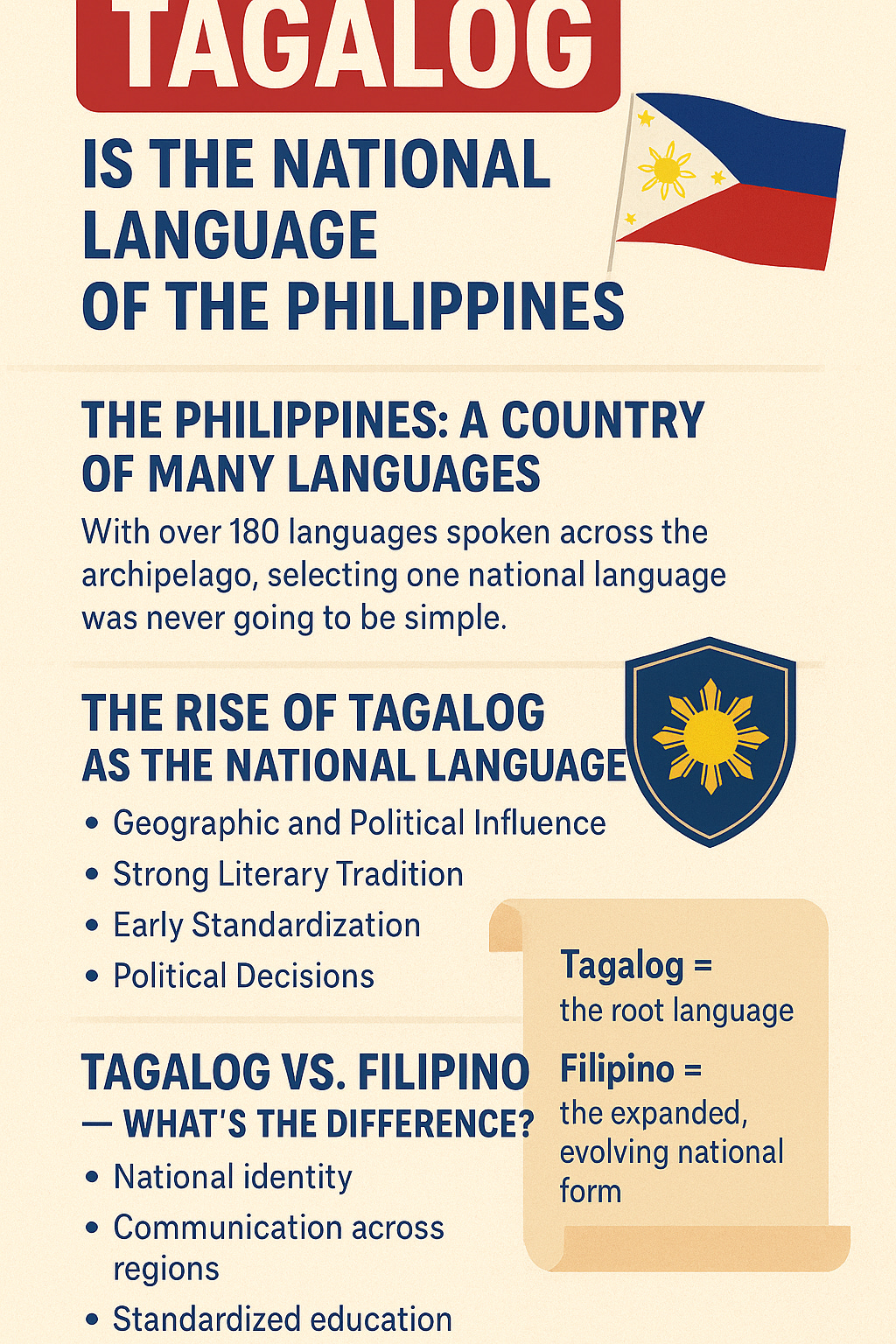
The Philippines: A Country of Many Languages
Before diving into Tagalog’s national role, it’s important to recognize that the Philippines is one of the most linguistically diverse countries in Asia. With over 180 languages spoken across the archipelago, selecting one national language was never going to be simple.
The choice wasn’t just linguistic — it was political, practical, and symbolic.
The Rise of Tagalog as the National Language
So why Tagalog is the national language of the Philippines can be traced across several key moments in history:
1. Geographic and Political Influence
During Spanish rule, Manila — the center of government, trade, and education — was predominantly Tagalog-speaking. Because of this, Tagalog naturally became more widespread in administration, literature, and formal communication.
2. Strong Literary Tradition
Tagalog had a well-developed written and oral tradition. Classic works like Florante at Laura and Noli Me Tangere helped elevate Tagalog’s prestige, showcasing its expressive style and cultural depth.
3. Early Standardization
Compared to other Philippine languages, Tagalog was standardized early. The creation of the Abakada alphabet and formal grammar guidelines made it easier to teach and promote nationwide.
4. Political Decisions
In 1937, President Manuel L. Quezon announced Tagalog as the basis of the national language due to:
Widespread use
Rich literary heritage
Simplicity in structure
Existing educational resources
This decision laid the foundation for what would later become Filipino, the modernized national language.
Tagalog vs. Filipino — What’s the Difference?
When discussing why Tagalog is the national language of the Philippines, it’s important to understand that Filipino (the official national language today) is based on Tagalog, but includes elements from other Philippine languages and foreign languages.
Think of it as:
Tagalog = the root language
Filipino = the expanded, evolving national form
While Filipino is more inclusive, Tagalog still forms the backbone — in vocabulary, grammar, and pronunciation.
Why the Decision Still Matters Today
Choosing Tagalog helped create a unifying language for a country spread across thousands of islands. It strengthened:
National identity
Communication across regions
Standardized education
Cultural continuity
However, discussions continue today about representation of other major languages like Cebuano, Ilocano, and Kapampangan. The evolution of Filipino aims to address this by incorporating terms beyond Tagalog.
Final Thought
Understanding why Tagalog is the national language of the Philippines gives us a deeper appreciation for how languages shape identity and unity. While the Philippines continues to celebrate its diverse linguistic heritage, Tagalog remains the foundation on which Filipino is built — a symbol of connection across a nation of many voices.