
If you’ve ever explored Filipino culture, visited the Philippines, or connected with Filipino communities online, you’ve likely heard Tagalog spoken in songs, movies, or casual conversation. But many people still wonder: what is Tagalog a mix of?
The answer is both fascinating and deeply tied to the history of the Philippines.
A Language Shaped by Centuries of Influence
Tagalog, the foundation of the national language Filipino, is not just a single-origin language. Instead, it’s a blend shaped by trade, colonization, migration, and cultural exchange.
Here’s what Tagalog is a mix of:
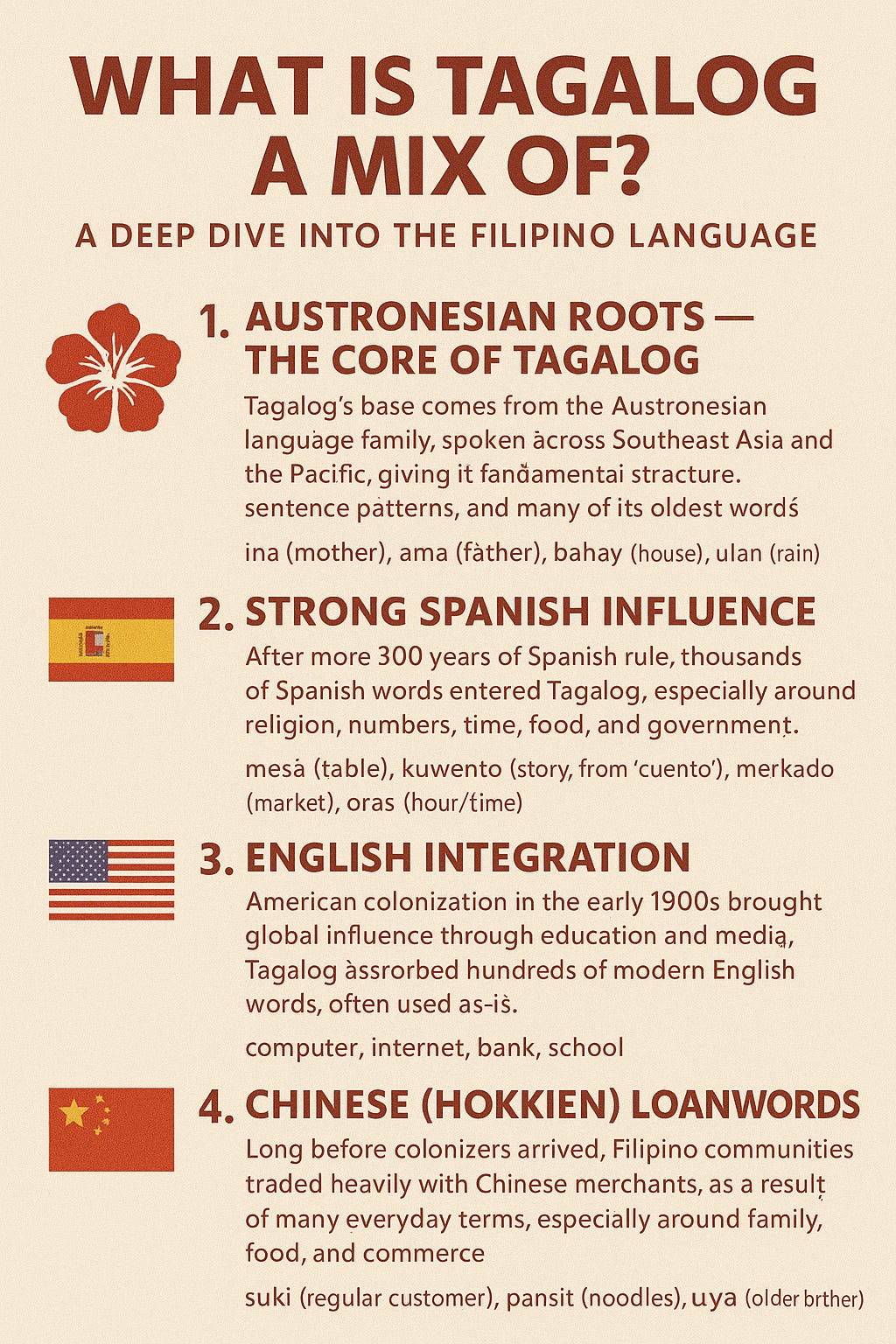
1. Austronesian Roots — The Core of Tagalog
Tagalog’s base comes from the Austronesian language family, spoken across Southeast Asia and the Pacific. This gives Tagalog its fundamental grammar structure, sentence patterns, and many of its oldest words—terms related to nature, family, and everyday life.
Examples include:
ina (mother)
ama (father)
bahay (house)
ulan (rain)
2. Strong Spanish Influence
After more than 300 years of Spanish rule, thousands of Spanish words entered Tagalog—especially around religion, numbers, time, food, and government.
Examples:
mesa (table)
kuwento (story, from “cuento”)
merkado (market)
oras (hour/time)
Today, about 20%–33% of everyday Filipino vocabulary includes Spanish-derived terms.
3. English Integration
American colonization in the early 1900s brought global influence through education and media. As a result, Tagalog absorbed hundreds of modern English words—often used as-is.
Examples:
computer
internet
bank
school
In modern Filipino conversations, it’s normal to hear “Taglish,” a blend of Tagalog and English.
4. Chinese (Hokkien) Loanwords
Long before colonizers arrived, Filipino communities traded heavily with Chinese merchants. This introduced many everyday terms, especially around family, food, and commerce.
Examples:
suki (regular customer)
pansit (noodles)
kuya (older brother)
5. Mexican & Latin American Influence
Through the Manila–Acapulco Galleon Trade, Mexican and Latin American culture left a mark on Tagalog vocabulary.
Examples:
tsokolate (chocolate)
kakaw (cacao)
sayote (chayote)
So, What Is Tagalog a Mix Of?
Tagalog is a rich linguistic tapestry, combining:
Austronesian native roots
Spanish vocabulary
English modern terms
Chinese trade words
Mexican & Latin American loanwords
This blend gives Tagalog its distinct rhythm, modern flexibility, and cultural depth—making it one of the most unique languages in Asia.
Why This Matters Today
Understanding what Tagalog is a mix of helps us appreciate how language evolves through history. It also gives learners an advantage—many words may already feel familiar because of these shared roots.
If you’re learning Tagalog or creating content around the Filipino language, leaning into these influences can make your journey easier and even more interesting.