
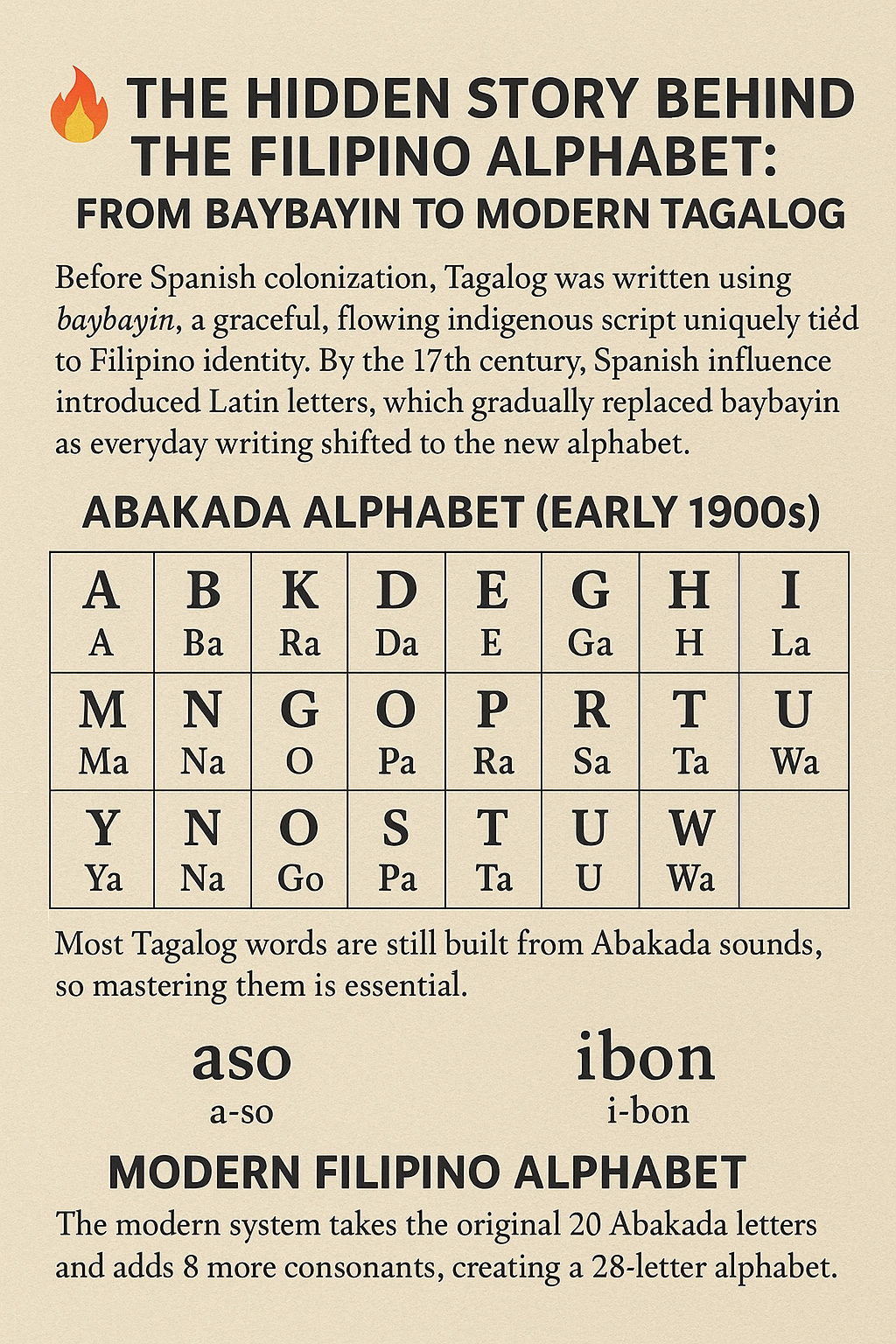
Before Spanish colonization, Tagalog was written using baybayin, a graceful, flowing indigenous script uniquely tied to Filipino identity. By the 17th century, Spanish influence introduced Latin letters, which gradually replaced baybayin as everyday writing shifted to the new alphabet.
To learn Tagalog as it’s spoken today, you’ll need to understand the Modern Filipino Alphabet, which evolved from the early Abakada system.
Abakada Alphabet (Early 1900s)
Created to represent the natural sounds of Tagalog, the Abakada consisted of 20 letters:
A B K D E G H I L M N Ng O P R S T U W Y
LetterSoundAA / Ba / Ka / Da / E / Ga / Ha / I / LaMMaNNaNGNgaOOPPaRRaSSaTTaUUWWaYYa
Most Tagalog words are still built from Abakada sounds, so mastering them is essential.
Examples:
aso → a-so → dog
ibon → i-bon → bird
Modern Filipino Alphabet
The modern system takes the original 20 Abakada letters and adds 8 more consonants, creating a 28-letter alphabet used across the Philippines today.
Perfecting these alphabets gives you a strong foundation for reading, speaking, and truly understanding Tagalog as it’s used in the modern world.