
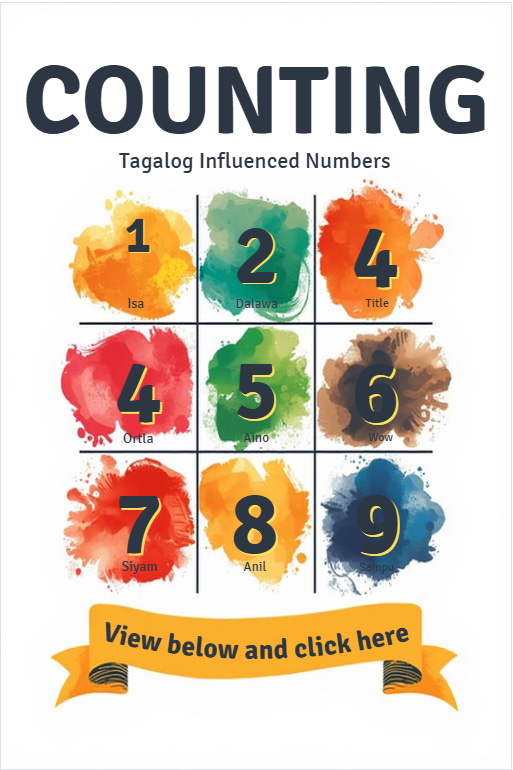
Filipino primary schools teach children to count in both Filipino and English. Because the Philippines experienced 373 years of Spanish colonization (1521–1898), Spanish-derived numbers also became deeply woven into everyday speech. Today, Filipinos commonly use a mix of Tagalog and Spanish numbers, depending on the situation.
Tagalog Numbers
English — Tagalog
one — isa
two — dalawa
three — tatlo
four — apat
five — lima
six — anim
seven — pito
eight — walo
nine — siyam
ten — sampu
eleven — labing-isa
twelve — labing-dalawa
thirteen — labintatlo
fourteen — labing-apat
fifteen — labinlima
sixteen — labing-anim
seventeen — labimpito
eighteen — labing-walo
nineteen — labinsiyam
twenty — dalawampu
hundred — daan
thousand — libo
million — milyon
Spanish-Derived Numbers in Everyday Use
Besides Tagalog counting, Filipinos often use Spanish-derived numbers when telling time, giving their age, or speaking casually—because they can be shorter and easier to say.
Example:
labindalawa (5 syllables) — twelve
dose (2 syllables) — twelve (Spanish-derived)
Tagalog vs. Spanish-Derived Numbers
Tagalog — Spanish derived
isa — uno
dalawa — dos
tatlo — tres
apat — kuatro
lima — sinko
anim — seis
pito — siete
walo — ocho
siyam — nueve
sampu — diez
How to Use Numbers With Objects in Tagalog
To describe a number of items:
Add “ng” after numbers ending in vowels
Add “na” after numbers ending in consonants
Examples:
pito(ng) isda — seven fish
isang bata — one child
anim na sapatos — six shoes
siyam na libro — nine books